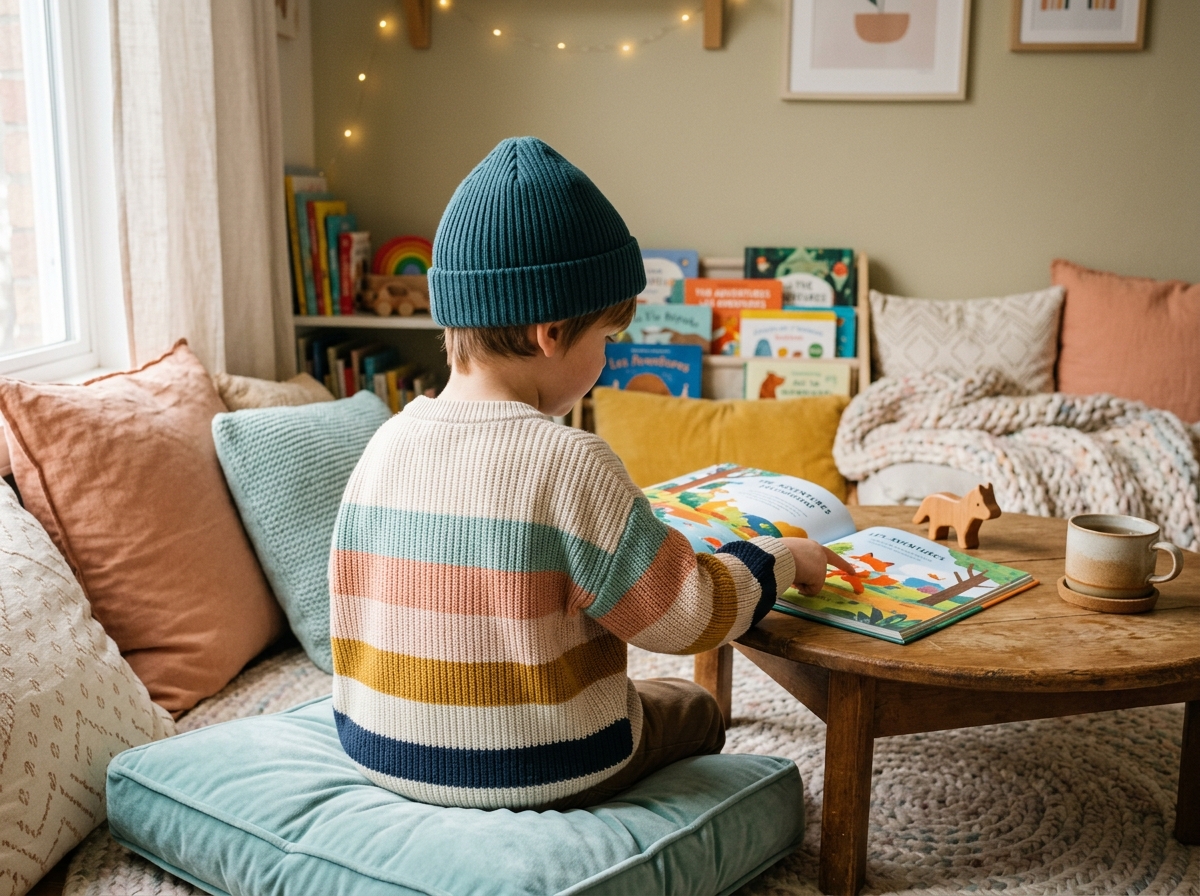
Language creeps up on you. One day your child is babbling, and the next they're saying "actually" in the middle of a sentence like a tiny professor, and you can't pinpoint when it started. That's what happened to us. So I started writing down the words Zayn picked up — the ones I didn't teach him, the ones that arrived while I was looking the other way.
Children learn language not from what you teach them, but from what they hear while you're not watching.
"Actually"
This was the first one that surprised me. He puts it in the middle of sentences, usually before a preference. "Actually, I want the blue one." "Actually, no nap." He uses it correctly, which means he's been listening to how we use it for months. I don't remember ever teaching him this word. He just absorbed it, the way you absorb the weather — by being in it.
"One more minute"
This one is on me. I say it all the time — "one more minute and then we go," "one more minute and then bedtime." And now he says it back to me, usually when I ask him to put his shoes on. "One more minute, Mama." It's both hilarious and a little bit humbling. He's been listening the whole time.
"Be careful"
I must say this twenty times a day. I didn't realize how often until I heard him say it — to his stuffed giraffe, who was apparently doing something risky on the edge of the couch. "Be careful, Gigi." I laughed, and then I thought about it, and I realized that the words I repeat become the voice in his head. That's a responsibility I hadn't fully considered.
The words you say most often become your child's inner voice. Choose them well.
"It's okay"
This one I'm proud of. When he drops something or bumps his knee, he says "it's okay" to himself before he cries. He learned it from me — I say it to him when things go wrong, and now he says it to himself. It's a small thing, but it tells me that the message landed. That when things break or hurt or fall, the first response can be gentleness. That's something I want him to keep.
"Where are you?"
He says this when he's looking for me, or for his father, or for the cat that lives downstairs. It's not a question he was taught — it's one he heard us ask, over and over, and now it belongs to him. There's something about hearing your own phrase come back in a small voice that makes you realize how much of parenting is just talking, and how much of what you say gets remembered.
What I learned
Writing down these words taught me something: I am his primary source of language, whether I'm trying to teach him or not. The things I say in passing — the offhand comments, the little phrases I repeat without thinking — those are the ones he picks up. Not the careful words I choose when I'm being intentional. The careless ones.
So I'm trying to be more careful with the careless words. Not because I want to control his vocabulary, but because the words he hears become the words he uses, and the words he uses become the way he sees the world. That's the real language lesson — not what I teach, but what I am.
He's still picking up words I don't notice. I'm still writing them down when I catch them. It's the most interesting record of his childhood that I keep — more honest than the photos, more specific than the milestones. Just the words, arriving one by one, while I'm looking the other way.